


Ghana has always punched above its weight in African music. A country of roughly 33 million people has produced artists whose influence extends across the continent and into the diaspora in proportions that no population statistic can explain. What explains it, if anything can, is a culture that has always taken music seriously: as art, as community, as a form of identity that travels. In 2026, the Ghanaian music scene is operating across multiple genres simultaneously, from drill to highlife to Afropop to dancehall, and the world is paying closer attention than at any point in the country’s musical history.
1. Black Sherif

There was a moment in 2022 when it became clear that Black Sherif was not simply a very talented young man from Konongo but something rarer: an artist with a complete and original worldview that expressed itself through music in a way that could not be mistaken for anyone else’s work. “Kwaku the Traveller” was the song that made this visible to the world, but his debut album The Villain I Never Was confirmed it. He rapped and sang in Twi, Pidgin, and English, addressing spiritual restlessness, ambition, and the specific pressures of young African life with a candour that his audience recognised immediately.
In 2026, Black Sherif is the artist that younger Ghanaian musicians most often name when asked who made them believe that an entirely local sound could find a global audience. His influence on the aesthetic choices of a new generation is already visible: the decision to stay in local languages, the willingness to address darkness and complexity without commercial gloss, the insistence that African music can be formally ambitious without being inaccessible. He is, at this moment, the most important thing happening in Ghanaian music.
2. Shatta Wale
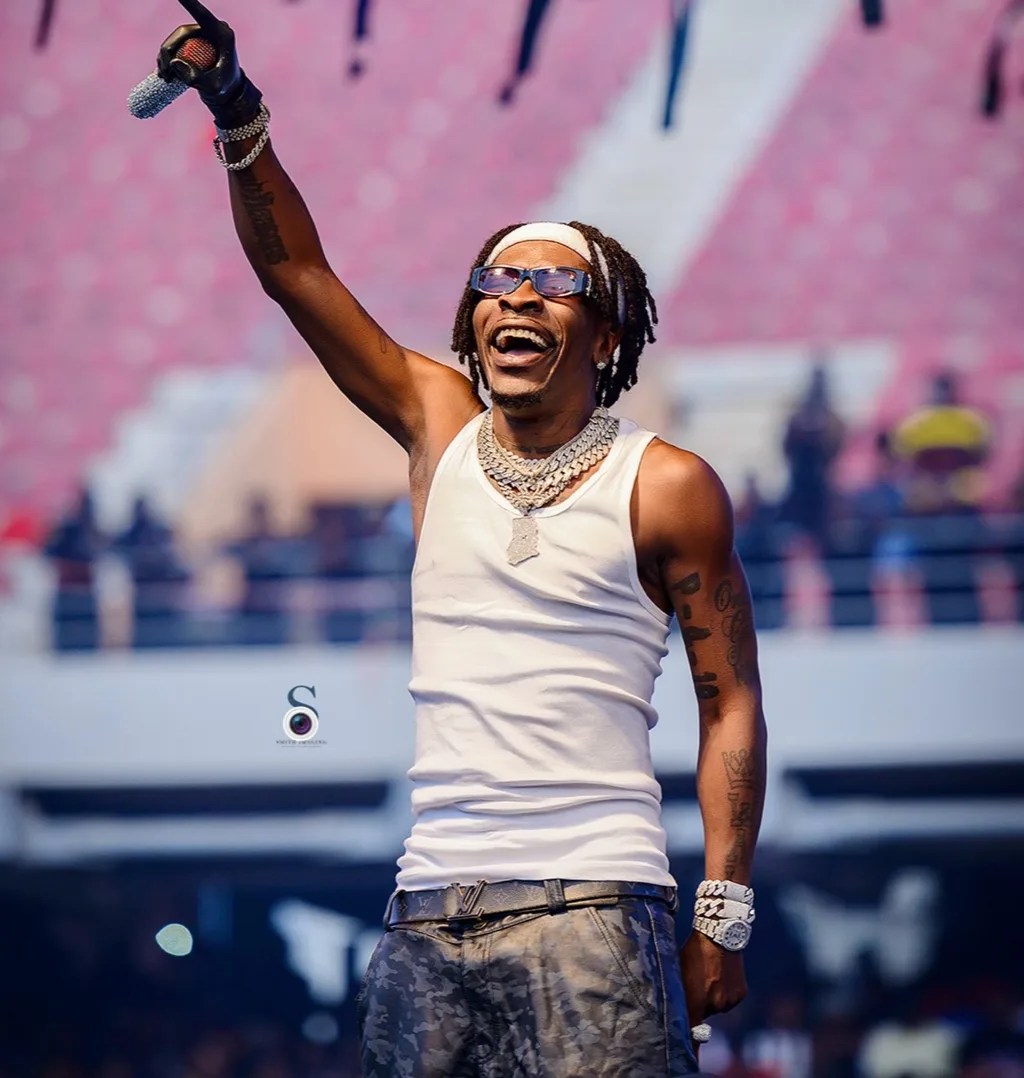
Shatta Wale has been the most dominant figure in Ghanaian dancehall for more than a decade, and in 2026 he is arguably more creatively productive than at any previous point in his career. His album African King, released in July 2026, is a 21-track project that moves through dancehall, trap, Afrobeats, and reggae without losing its identity, which has always been his specific combination of melodic sharpness and performance conviction. As a solo project with no guest artists, it is the most unfiltered statement he has made.
What makes Shatta Wale important beyond his individual achievements is what he represents for Ghanaian music infrastructure. He built his following through a combination of prolific output, direct engagement with fans, and an insistence on performing music that was unapologetically rooted in Accra’s street culture at a time when the industry rewarded a different kind of polish. In 2026, the model he established is being followed by a generation of Ghanaian artists who understand that authenticity and commercial success are not opposites.
3. Stonebwoy
Stonebwoy occupies a specific position in Ghanaian music: he is the artist who proved that West African dancehall and reggae could earn genuine respect from the Jamaican originators of those forms while simultaneously building a massive continental following on their own terms. His BHIM Nation movement created a community as much as a fanbase, and his live performances remain among the most compelling in African music. His collaboration with Chance the Rapper on “Paradise” demonstrated an international reach built through genuine musical quality rather than marketing.
In 2026, Stonebwoy continues to produce music that balances dancehall’s rhythmic foundations with Ghanaian melodic traditions and lyrical themes that reflect the daily realities of his audience. His longevity in a market that cycles through new voices quickly says something about the depth of his connection to the people who listen to him. He is one of a small number of Ghanaian artists whose career has consistently grown rather than peaked and flattened.
4. Sarkodie

Sarkodie is the most decorated rapper Ghana has produced, with a career that has accumulated multiple BET Hip Hop Awards and more mainstream Ghanaian music awards than any other artist in the country’s history. More importantly, he has done it while maintaining a distinctly Ghanaian voice: rapping in Twi and Pidgin, engaging with local political realities, and collaborating with artists across Africa rather than prioritising the American or British market above all others. His feature on Black Sherif’s “Second Sermon (Remix)” introduced him to a new generation of listeners who might otherwise have known him only by reputation.
In 2026, Sarkodie remains one of the most technically accomplished rappers working in African music. His verse construction, his ear for production, and his ability to switch registers within a single track are skills that do not age with trends. Younger Ghanaian rappers study him the way a previous generation studied Jay-Z or Nas, and that influence continues to shape the standards of craft expected within the local scene.
5. KiDi
KiDi arrived as part of a generation of Ghanaian Afropop artists making music that could sit comfortably next to Nigerian releases on streaming playlists while still carrying something distinctly Ghanaian in its harmonic sensibility and lyrical preoccupations. His voice is one of the most controlled and musically intelligent in the current generation of West African singers: capable of a warmth that makes even simple observations sound like intimacies, and of a precision that reveals itself slowly over repeated listens. Songs like “Say Cheese” and “Touch It” showed that romantic Afropop could be well-crafted and commercially successful simultaneously.
In 2026, KiDi continues to release music that treats production quality as a non-negotiable baseline and songwriting as the actual work. His presence in the Ghanaian music conversation is as a standard-setter: an artist whose output reminds others that the details matter and that an audience with access to world-class music from every corner of the globe can tell the difference.
6. Kuami Eugene
Kuami Eugene’s career arc is one of the more remarkable in recent Ghanaian music. He emerged through a talent competition, which in most industries would mark him as someone the system identified and shaped, but his music has always felt personal: rooted in highlife and traditional Ghanaian sounds, carried by a tenor voice of genuine warmth and flexibility. “Dollar on You,” “Confusion,” and “Wish Me Well” are songs that function across the commercial and artistic spectrum, feeling like genuine expressions of feeling rather than products calculated for a specific outcome.
What Kuami Eugene represents in 2026 is the continuation of Ghana’s highlife tradition through the language of contemporary Afropop, done with enough sincerity that neither the traditionalists nor the new streaming audience feels misled. He is one of those artists whose greatest skill is making complex balancing acts appear effortless, and in a music environment that increasingly rewards exactly that combination, he is well-positioned for the years ahead.
7. King Promise

King Promise has built a reputation as one of the most melodically generous songwriters working in Ghanaian music, an artist for whom the hook is not a commercial calculation but an expression of something genuinely felt. His voice carries a sweetness that does not tip into softness, and his production choices consistently prioritise the human element over the technical flourish. Songs like “Slow Down” and “Terminator” have found audiences across West Africa, and his collaboration with UK rapper Headie One on “Ginger” demonstrated an ability to code-switch across musical cultures without losing the thread of what makes his music distinctively his.
In 2026, King Promise is in the phase of his career where critical and commercial recognition is beginning to catch up with the quality of the work. His consistency over several years of releases has built a foundation that allows each new project to be received as a known quantity, which is a different and arguably more sustainable position than the sudden breakthrough that many younger artists experience before the audience has properly decided what it thinks of them.
8. Amaarae
Amaarae occupies a position in Ghanaian music that no one else is currently filling: she makes music that draws on R&B, Afropop, and alternative pop in proportions that feel genuinely personal rather than genre-strategic, and she does it in a falsetto register that is immediately recognisable from the first few seconds. Her breakout song “SAD GIRLZ LUV MONEY,” which received a remix featuring Kali Uchis and Moliy, reached audiences in North America and Europe who had limited previous exposure to Ghanaian pop, and it did so without presenting itself as anything other than exactly what it was.
In 2026, Amaarae is the artist who most clearly points toward where Ghanaian music might go next: less interested in the commercial Afrobeats lane and more concerned with making work that operates on its own aesthetic terms. Whether that turns out to be a narrow path or the main road depends on what the next few years produce, but her presence in the conversation is a sign that the scene has room for more than one definition of success.
9. Kweku Smoke
Kweku Smoke emerged from the Asakaa movement in Kumasi alongside artists like Jay Bahd and O’Kenneth, and he distinguished himself within that scene through a vocal approach that combined the drill template with something more melodic and emotionally direct than the genre typically permits. His music addressed the realities of life in Kumasi’s streets without romanticising them, and the specificity of his observations gave his records a weight that broader, more aspirational music often lacks. He has been one of the most consistent voices in Ghanaian drill since the genre’s local emergence.
In 2026, Kweku Smoke represents the continuing development of a sound that originated in specific Ghanaian circumstances and has since been adopted, adapted, and debated across the continent. His refusal to simplify his music for markets that might find the Kumasi specificity unfamiliar is part of what makes his work valuable, and it is the quality that will ensure his influence outlasts the moment of the movement’s initial mainstream attention.
10. Kwesi Arthur
Kwesi Arthur has maintained a position in Ghanaian music as one of its most thoughtful and lyrically careful voices, an artist for whom a song is not simply a vehicle for a catchy melody but an opportunity to say something worth saying. His international collaboration with American artist Russ on “Coming Home” introduced him to a new cohort of listeners, but his Ghanaian catalog, built around a combination of Afropop sensibilities and introspective rap, has always been where his identity was clearest. He is an artist who attracts listeners who want more than energy from a song.
In 2026, Kwesi Arthur’s continued presence in the conversation says something about the depth of the Ghanaian scene. There is room for Black Sherif’s intensity, Shatta Wale’s dominance, and Kwesi Arthur’s quieter, more considered approach simultaneously. That coexistence is what makes the current moment in Ghanaian music feel genuinely interesting rather than simply commercially productive.
In 2026, Ghana’s music is not a single thing. It is a set of conversations happening in parallel, between generations, genres, cities, and worldviews, connected by a shared commitment to making music that matters. These ten artists are the loudest voices in those conversations right now, and the rest of the continent is listening.


